

Lehi, Utah Growth: The House That Watched a Farm Town Become a Boomtown
Lehi, Utah grew from a farming community into the heart of Silicon Slopes in a single generation. From inside the old Holbrook family home, here is how Holbrook Farms, Sky View, traffic, water, and new development are reshaping the city.
I live in the old Holbrook home in Lehi. My wife is a granddaughter of the Holbrook family; her mother was raised in this house. Like a lot of Lehi farm families, the Holbrooks lived in town and went out to the farm ground every day to work it, season after season, generation after generation.
So when people ask me what I think about Lehi's growth, I'm not answering from a listing sheet. I'm answering from inside the house that watched it happen.
In this house, the ritual never changed. Covered in the fine dust of a Utah summer, Garn would slip through the side door and head straight down the basement stairs, leaning backward and tilting his head to one side beneath the low ceiling while carefully navigating each awkwardly narrow step.
My wife's uncle Scott remembers it exactly: a furnace room so large it took up two-thirds of the basement, one dim light bulb, always warm. Dad (Garn) kept an old wood chair beside it, and that's where he'd sit and read, often preparing a Sunday School or priesthood lesson. A farmer's study: one bulb, one chair, the warmest room in the house.
Then back up the narrow stairs to the kids: David, Steve, Scott, Bryce and the daughter who would grow up to become my mother-in-law, Susan.
Those same narrow stairs are the first thing I touch every morning on my way down to my exercise bike. Well, maybe more like twice a week. The Holbrooks changed out of field clothes and prepared Sunday lessons down there; I occasionally sweat on a stationary bike. Progress is humbling.
And right now, with the Sky View development rising on the east side and cranes becoming our unofficial city bird, it feels like the right time to tell you how Lehi got here through one family's story, because it's the same story as the town's.
How did Lehi, Utah grow from a farm town into a boomtown?
Faster than anyone was ready for.
I'm a transplant myself. I grew up in Lompoc, a farming town near Santa Barbara, until seventh grade, spent my high school years in Boise, and made my way to Utah as a young man. Before Lehi was my home, the only thing I could have told you about it was one building: the Lehi Roller Mills, the flour mill from Footloose, where Kevin Bacon's character worked and danced his way through the warehouse. For decades, that was Lehi's entire claim to fame: flour and one very angry dance scene.
Then Silicon Slopes happened.
The 2020 census counted 75,907 people here; recent estimates put us close to 100,000. Adobe, Microsoft, Oracle, Texas Instruments, and the rest turned a quiet farm town into one of the fastest-growing cities in America.
The mill still stands along I-15, by the way. It is a hundred-year-old landmark now watching roughly 190,000 vehicles drive past it every day.
But "farm town" isn't a marketing phrase for Lehi. It's a fading memory. This was once a place where families measured the year in cuttings of alfalfa, not product launches or quarterly deadlines.
Lehi traded fields of combines for pavement surrounding Adobe, Porsche, Audi, and Range Rover dealerships and, if the rumors are true, maybe even a Trader Joe's. Fingers crossed.
What happened to the Holbrook family farm in Lehi?
My wife's family farm tells the whole story.
It was a true century farm. The family's grandfather bought the ground during the Great Depression, and the Holbrooks worked it for the next hundred years. The alfalfa they grew fed animals at Hogle Zoo and Thanksgiving Point. A railroad once crossed the property carrying soldiers to Camp Williams.
The Holbrook farm also had an old windmill. Today, it stands in the middle of a neighborhood traffic circle in the Holbrook Farms development, no longer surrounded by open farmland but preserved as a small reminder of the world that used to surround it.
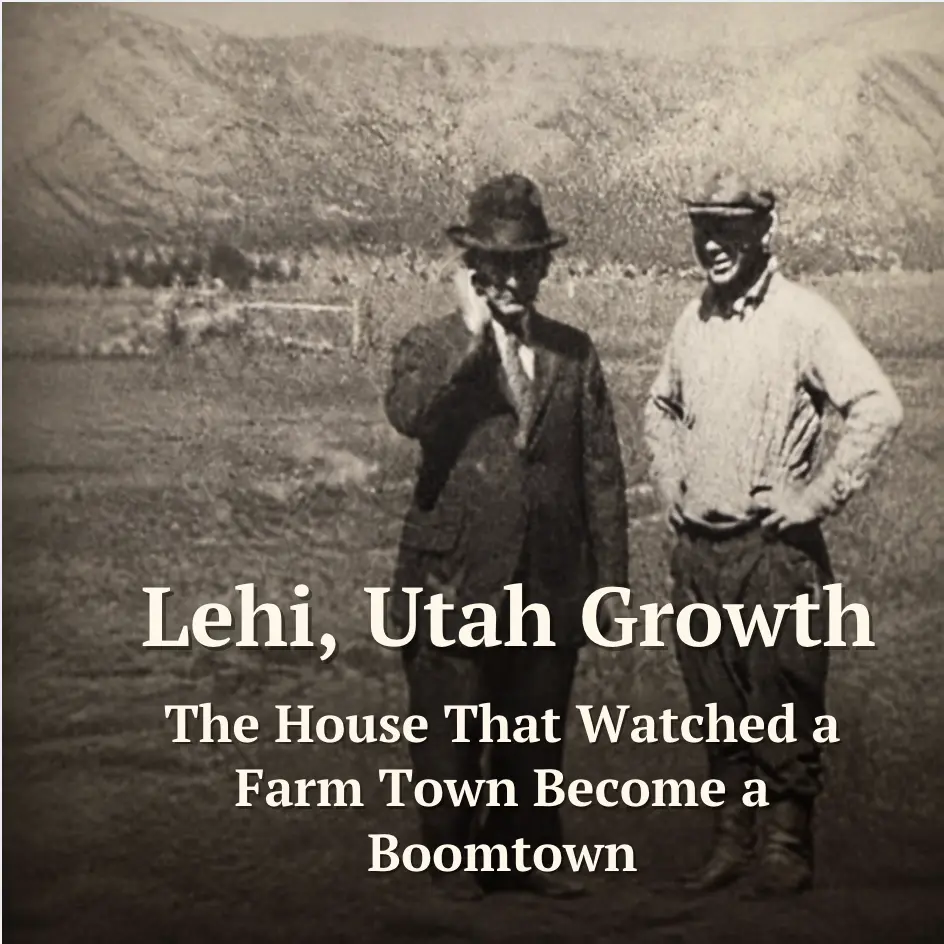
The family history book on our shelf holds the proof in sepia: Horace C. standing on the farm in 1932, the same Lehi ridgeline behind him that's behind the construction cranes today, and the whole crew lined up by the Jordan River in 1944, a couple of .22s pointed at tin cans, Garn and Susan among the names printed underneath.
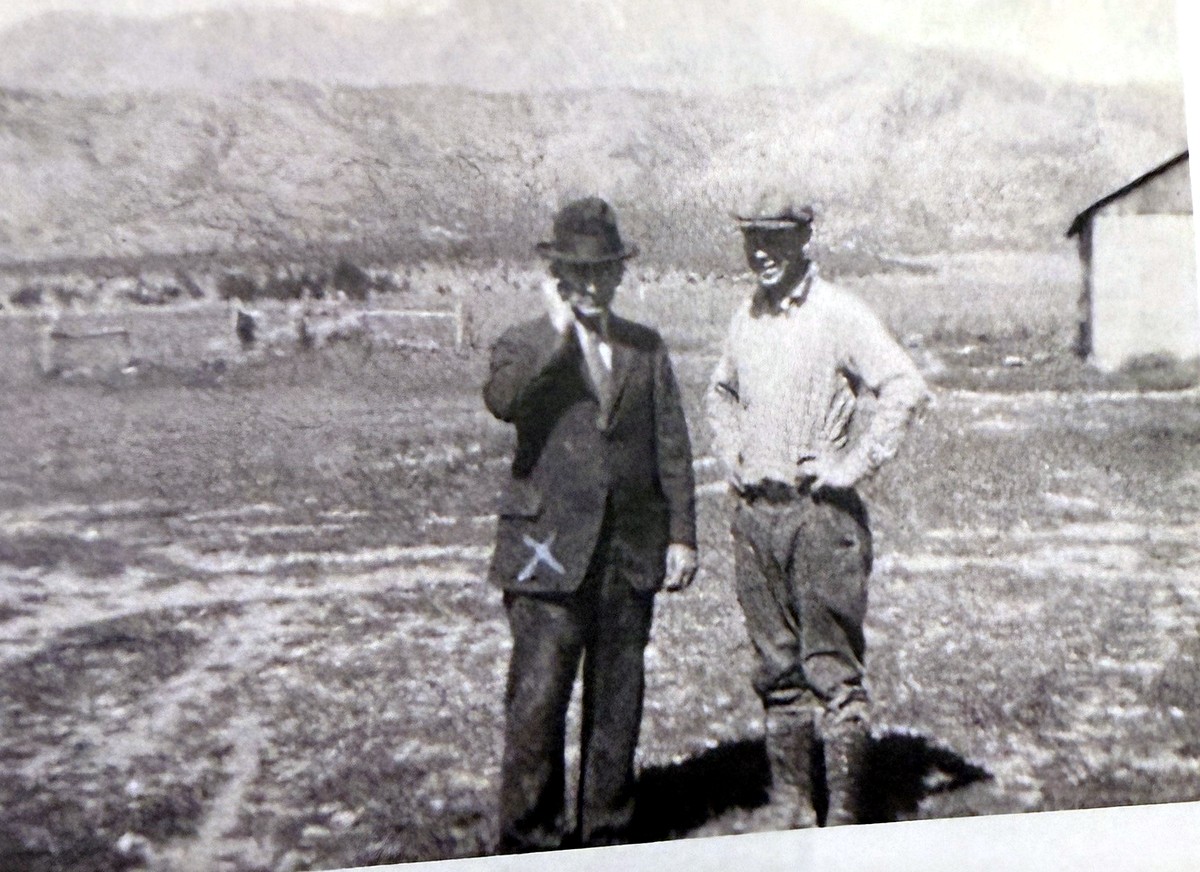
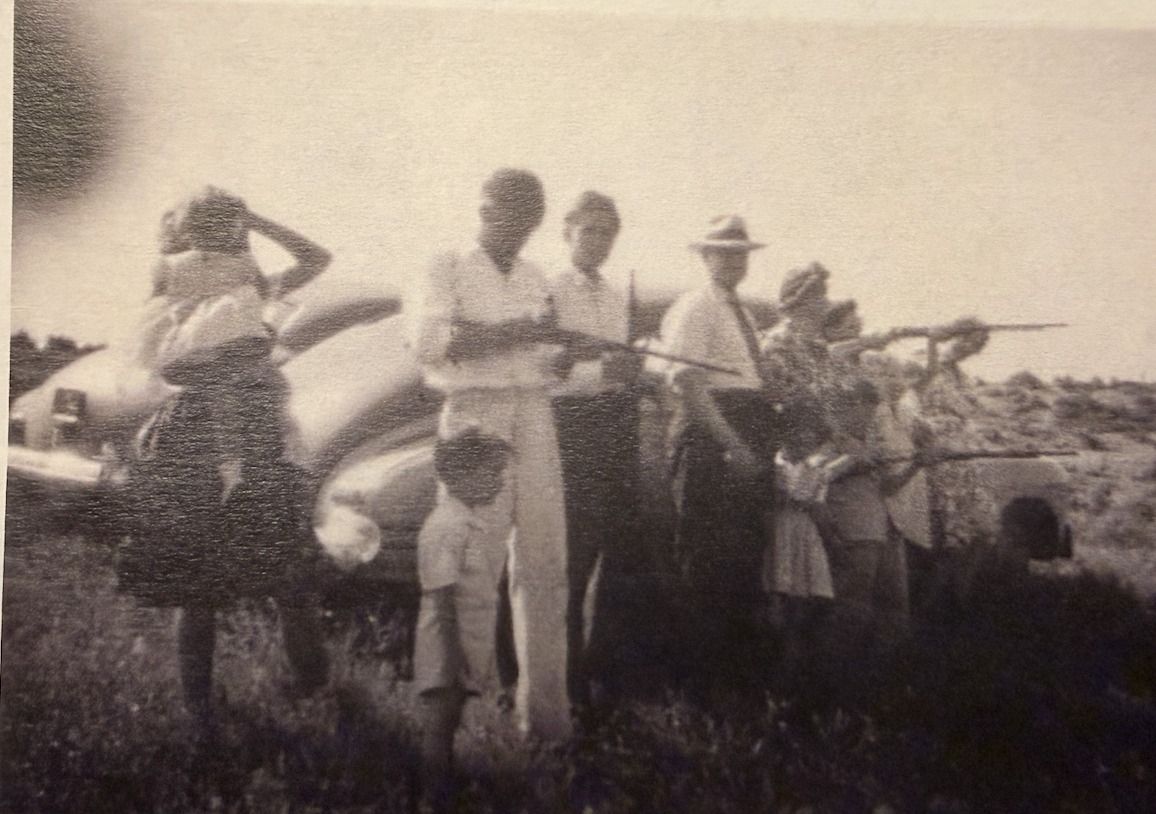
Ninety years later, same mountains, different harvest.
In April 2015, the family, including those boys who once waited at the top of the narrow stairs, Steve and Scott, sold 686 acres to Ivory Homes.
Today that ground is Holbrook Farms, a master-planned community where thousands of people live, with parks, trails, schools and, wouldn't you know it, a Quick Quack Car Wash.
I won't pretend there isn't something bittersweet about that. There is. My brother-in-law Brook, short for Holbrook of course, can still tell you what grew where because he spent so many teenage summers in those fields, moving pipe, picking up rocks, and blasting Megadeth from an old Sony cassette player while he drove a combine back and forth for hours.
But here's what the family understands better than most: the Holbrooks commuted from their Lehi home out to their work every morning, and now thousands of families in Holbrook Farms do exactly the same thing. They just drive to the office suite instead of the fields of wheat, beans and alfalfa.
Both eras are true Lehi.
And here's the part that surprises transplants like me: the small-town life didn't disappear under the construction cranes.
Our summers still feel like something out of The Sandlot, with kids roaming the neighborhood and playing night games. My backyard certainly looks the part. Lit like a minor league ballpark by 110,000 lumens of LED lights, it draws boys from blocks around for wiffle ball games that last long after they should have gone home.
The Lehi Roundup Rodeo is only blocks from our front door, close enough that, before he passed away in 2020, we could hear legendary rodeo clown Lecile Harris working the crowd. In a town changing as quickly as Lehi, Lecile was famous here—one of those rare figures the old farming families and the newest arrivals both seemed to know.
Some came to cheer on friends and family because farming and rodeo were not costumes to them; they were simply life. Others buttoned up a pearl-snap shirt, pulled on a pair of boots, and spent the evening channeling Lane Frost, even if the puka-shell necklace peeking above the collar gave them away. Nobody seemed to mind. In Lehi, the families who had worked this ground for generations and the newcomers trying on the culture for a night could sit in the same bleachers, cheer for the same cowboy, and both feel like they belonged.
The Lehi Roundup parades pass the end of my street, where the sidewalks fill shoulder to shoulder and candy rains from every float. Hella candy. The moment it hits the hot asphalt, children and grown adults alike spill into the road, scrambling to fill their bags before the next handful lands.
The spectacle always sparks the same debate. Old-school Lehi families insist it is perfectly safe because they did it as kids and survived. Newer residents—whom the old-timers may consider a little overprotective—watch children dart into an active street between moving floats and wonder how anyone could call this safe. I have stood along that parade route many times, and in this particular moment, both sides are absolutely right. It is a glorious opportunity to fill a bag with free candy, and it is also wildly dangerous to watch children charge into the street to rescue a piece of saltwater taffy already gritty with asphalt.
That's the thing nobody tells you about Lehi in 2026: the boomtown and the small town reside as neighbors who will wave to each other as they pass.
What is the Sky View development in Lehi, Utah?
Sky View is the current chapter of that same story, this time on the east side near Traverse Terrace Drive and Center Street.
It's one of the largest projects in Lehi's history, with hundreds of acres planned for thousands of homes and apartments, retail, offices, and a new temple for The Church of Jesus Christ of Latter-day Saints planned near 3950 North and Center Street.
The headline piece is The Shops at Sky View: 97 acres just north of Timpanogos Highway with nearly 300,000 square feet of retail across 15 buildings, 307 residential units, and up to 316,000 square feet of office space.
A new Target and a Life Time fitness club are already under construction, with the first phase expected in 2027. Just north, D.R. Horton's Inverness development is adding more than 2,400 homes.
Watching it rise feels familiar in this house.
We've lived this story before.
What does Lehi's growth mean for homebuyers?
Two honest truths.
First: convenience supports value. Homes near Sky View will soon be minutes from a Target, restaurants, offices, and a temple, with Skyridge High about a mile away and Viewpoint Middle and Belmont Elementary close by. That's a strong long-term recipe.
Second: the in-between years are real, and so is the traffic.
Here's how real: before I let a client write an offer on a home in Saratoga Springs or Eagle Mountain, both of which you have to pass through Lehi to get to, I make them drive out there during rush hour. That's not a figure of speech. It's a rule I actually enforce, because that drive is horrible at 5:15, and I'd rather lose a sale than have someone discover it after closing.
And I'll say the uncomfortable part out loud: we're hurting for water.
Restrictions are part of summer life here now, and still we grow, grow, grow. That math deserves an honest conversation, not a PowerPoint plan nobody watches at a public meeting.
Growth brought the restaurants, the jobs, and the trail system; it also brought the cones, the boundary shuffles, and real pressure on the resources under our feet. You don't get one without the other, and anyone who tells you otherwise is selling you something.
And yet, somehow, through the parades, the rodeo, and the hella candy, it still feels like a small town.
I can't fully explain that.
I just live it. And I am never going to leave it.
Is Lehi, Utah a good place to buy a home?
If you want to plant your family somewhere with real momentum, including jobs, schools, and mountains out the window, then yes.
Buying near the growth before the amenities are finished is how you get in ahead of the value instead of paying for it afterward.
But if you need a town that will look the same in ten years, Lehi will break your heart a little.
Before you buy near Sky View or anywhere in Lehi, drive your actual commute during rush hour. Verify your school boundary directly with the district because boundaries here continue to change. Ask what is planned for the empty parcels closest to the home.
In Lehi, an open field is rarely just an open field.
It is usually the next chapter.
Lehi will keep changing. More fields will become neighborhoods. More cranes will rise. More families will arrive and begin measuring their lives here in school years, commutes, rodeos, and summers beneath the same mountains.
But down in my basement, the old light Garn once turned on with the tug of a chain still hangs from the ceiling. Its warm glow has not changed, even though nearly everything beneath it has. The furnace room that once took up two-thirds of the basement, where Garn sat beside the heat and prepared Sunday lessons, is now a home theater lined with posters from my favorite movies. In the old office, my teenage son, Garn's great-great-grandson, now sleeps beneath the glow of LED lights, with a Bluetooth speaker on the dresser and a Nintendo Switch 2 charging beside his bed.
The house did not lose its history when it made room for us. It simply learned how to carry both stories at once.
Maybe that is what I love most about Lehi. Even as it becomes something new, pieces of what came before are still here: a pull-chain light hanging next to the home theater, a windmill standing in the middle of a neighborhood. And the new has given us things worth loving too: afternoons spent among dinosaurs, butterflies, and tulips at Thanksgiving Point's Ashton Gardens, five-dollar movies at the Megaplex, and more ways for families to make memories close to home. The old and the new do not cancel each other out. One gives the other context, and both still belong.
Same mountains. Different harvest.
Categories
Recent Posts





GET MORE INFORMATION